Key Factors to Consider When Engaging an Asphalt Paving Contractor
Key point:
Verify a contractor’s accreditations, equipment, and local project experience before committing to any paving work.
Asphalt mix selection, surface preparation, and weather timing directly affect pavement lifespan.
Properties across Central Coast, NSW benefit from contractors familiar with regional traffic loads, soil conditions, and council requirements.
Choosing a qualified provider of Asphalt Paving Services requires looking beyond price quotes to examine accreditation, equipment capability, and project history. A contractor’s qualifications and process control largely determine whether a new surface holds up under years of vehicle traffic, weather exposure, and ground movement.
Asphalt failures rarely stem from the material itself. They typically trace back to inadequate preparation, incorrect mix selection, or compaction errors made during installation. Reviewing a contractor’s track record on comparable projects, whether residential driveways, car parks, or council roadworks, gives a clearer picture of reliability than advertised pricing alone.
Accreditation and Compliance Standards
Asphalt contractors working on public infrastructure or council-managed roads in NSW are often required to hold prequalification status with road authorities. This prequalification confirms a contractor has met defined standards for workmanship, safety management, and quality systems before being approved for larger civil or government contracts.
Relevant certifications to check include:
Prequalification with NSW Roads & Maritime Services or Transport for NSW for asphalt and traffic control work
Third-party accreditation for safety management systems (AS/NZS 4801)
Environmental management certification (ISO 14001)
Quality management certification (ISO 9001)
Mix specifications and placement standards for NSW roadworks are governed by formal technical requirements, which property owners can reference through Transport for NSW standards.
Equipment, Materials, and Process Capability
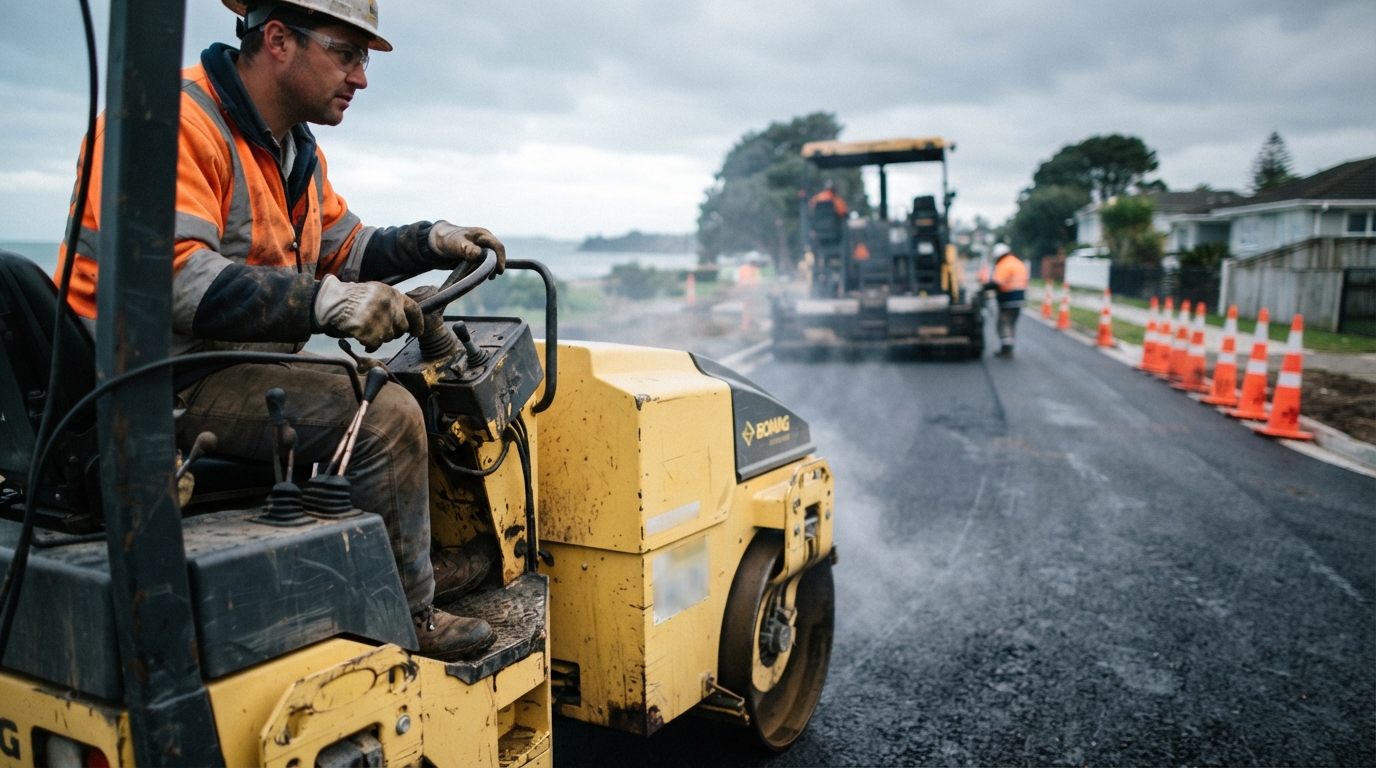
The scale and condition of a contractor’s plant and equipment fleet affects both project timelines and surface quality. Larger paving jobs, particularly commercial car parks or council roadworks, require consistent asphalt supply and heavy compaction machinery to avoid cold joints and uneven density.
Key process elements worth confirming before engagement:
| Factor | What to Ask | Why It Matters |
| Asphalt source | Is asphalt manufactured on-site or trucked from elsewhere | Affects temperature control and delivery timing |
| Mix design | Does the mix include recycled asphalt pavement (RAP) | Influences durability and sustainability |
| Compaction equipment | What rollers and stabilising gear are used | Determines long-term surface density |
| Materials testing | Is there an accredited laboratory for quality checks | Confirms mix meets specification |
Contractors who manufacture their own asphalt and operate dedicated stabilising and haulage equipment typically maintain tighter control over mix consistency and delivery scheduling than those relying on third-party suppliers.
Regional Conditions Affecting Asphalt Performance
Properties and infrastructure across Central Coast, NSW experience a coastal climate with seasonal heavy rainfall, humidity, and periods of high UV exposure. These conditions accelerate oxidation and can contribute to cracking or surface deterioration if asphalt is laid without correct compaction or drainage falls.
Ground conditions in coastal and semi-rural areas can also vary significantly within short distances, affecting how a base layer should be prepared before surfacing. A contractor familiar with regional soil behaviour and drainage patterns is better placed to recommend appropriate pavement thickness and base preparation for a given site.
Seasonal timing matters too. Asphalt placement is sensitive to surface and ambient temperature, so scheduling work outside of extreme heat or sustained wet periods reduces the risk of premature surface defects.
Scope of Work and Project Type
Asphalt paving covers a range of project types, from small residential driveways to large-scale civil construction and spray sealing for lower-traffic surfaces. Confirming that a contractor’s experience matches the scale and type of the intended project, rather than assuming all asphalt work is interchangeable, helps avoid mismatched expectations.
Questions to raise during the selection process include:
1. Has the contractor completed projects of similar size and traffic load
2. Does the quoted scope include surface preparation, base repair, and compaction, not just topcoat application
3. Are materials testing and quality documentation provided after completion
4. What warranty or defect liability period applies to the finished surface
Frequently Asked Questions
How long does newly laid asphalt take to cure? Asphalt typically reaches initial compaction strength within a day but can take several weeks to fully cure and harden, depending on thickness, mix type, and weather conditions.
What causes asphalt to crack prematurely? Common causes include inadequate base preparation, poor drainage, insufficient compaction during installation, and water infiltration beneath the surface layer.
Is recycled asphalt pavement (RAP) suitable for driveways and car parks? RAP can be incorporated into asphalt mixes at approved percentages without compromising performance, provided it meets relevant materials specifications.
How often should asphalt surfaces be resealed? Resealing intervals depend on traffic volume, climate exposure, and original mix quality, so a site-specific inspection is the most reliable way to determine timing.
Business Information
Based in Tomago, NSW, Newpave Asphalt Tomago serves customers throughout the Central Coast, NSW.
Property owners planning paving work can Read More to review current service area and operational details.