Electronic Prior Authorization Automation: Boost Revenue

Physicians and staff spend an average of 14.6 hours per week on prior authorization work, according to market analysis citing AMA burden data. For a hospital leadership team, that isn’t just an administrative irritant. It’s a direct drain on labor, throughput, scheduling, and cash flow.
Electronic prior authorization automation matters because prior auth sits at the front end of revenue realization. When requests are delayed, incomplete, or routed through fragmented payer workflows, denials rise, treatment starts slip, and accounts receivable age for reasons that have nothing to do with clinical quality. The organizations that treat ePA as a revenue cycle capability, not a narrow IT project, usually make better decisions about scope, staffing, and return.
The Escalating Cost of Manual Prior Authorization
Physicians and staff already spend 14.6 hours a week on prior authorization work, as noted earlier. For an executive team, the more important question is what those hours displace. Manual prior auth pulls skilled labor into status checks, document collection, payer follow-up, and rework instead of patient access, clinical support, and clean revenue capture.
That cost hits long before a claim is denied.
For hospital finance leaders, manual prior auth creates expense on the front end and instability on the back end. The front end absorbs labor from scheduling, registration, utilization management, and clinic staff. The back end absorbs the consequences when an authorization is incomplete, expires, is tied to the wrong service, or never reaches the payer in the correct format. By the time the issue appears as a denial or delayed payment, the original failure is harder to trace and more expensive to correct.
Where the cost shows up
Manual prior authorization rarely sits in one queue. It spreads across departments and creates failure points at each handoff.
A common pattern looks like this:
-
Scheduling delays: Teams hold appointments or procedures because authorization status is unclear.
-
Clinical rework: Nurses, medical assistants, and physicians stop to supply missing notes, orders, or payer-specific attachments.
-
Revenue leakage: Avoidable denials and appeals surface later, after the service is delivered and the account has already aged.
-
Limited visibility: Leaders see denial trends and AR pressure, but the authorization defect that caused them often stays buried in email, spreadsheets, portal messages, and fax trails.
Manual prior auth is one of the few administrative processes that can weaken patient access, staff productivity, and net revenue at the same time.
The staffing response is often understandable and usually incomplete. Adding headcount can reduce backlog for a while, but it does not fix a workflow built on payer portals, phone calls, faxes, duplicate data entry, and inbox triage. High-volume service lines feel this first because documentation requirements are heavier and payer variation is harder to manage consistently.
Leaders who want a broader view of the operational pressure can examine GeBBS’ perspective on prior authorization as a growing challenge in healthcare.
Why this has become a board-level issue
Prior auth now affects enterprise performance, not just departmental productivity. Delayed approvals slow treatment progression, create avoidable friction for physicians, and interrupt the timing of revenue. They also expose a structural weakness in the revenue cycle. If results depend on a small number of experienced staff who know each payer’s unwritten rules, the process is fragile.
That is the business case for automation. RPA and NLP are not interesting because they are new. They matter because they reduce manual touches, standardize submission quality, shorten approval cycle times, and give leadership a clearer line between authorization performance and financial results.
Decoding Electronic Prior Authorization Automation
Electronic prior authorization automation is best understood as a coordinated digital workflow that replaces fragmented manual handoffs. It connects the provider’s clinical and registration systems to the payer’s rules, intake methods, and response channels, then routes the request with the required information attached.

If manual prior auth is a patchwork of phone calls, faxes, PDFs, and portal logins, automated ePA acts more like a digital courier that understands both sides. It can pull patient and order data from the provider environment, match that request to payer-specific requirements, package supporting documentation, submit through the correct channel, and track status without relying on someone to keep checking.
What it actually does
At a practical level, electronic prior authorization automation usually handles a sequence like this:
- Detect the need for authorization based on payer, service, and benefit context.
- Gather the case inputs from the EHR and related systems.
- Identify what’s missing before submission.
- Submit through the right route, whether that’s an API, clearing workflow, or payer portal.
- Monitor responses and pend status until a decision is returned.
- Write results back to the work queue or downstream system so staff can act.
That sounds straightforward, but the value is in reducing avoidable touches. When a team stops re-entering demographics, attaching the wrong note, or missing a payer-specific question, first-pass quality improves.
What ePA automation is not
It’s not one button. It doesn’t mean every case becomes zero-touch. And it doesn’t remove the need for human judgment on clinically nuanced requests.
The better way to think about it is selective automation. Straightforward requests should move with minimal human effort. Complex cases should reach staff with context already assembled, rather than forcing staff to build the case from scratch.
The strongest ePA programs don’t try to remove people from the process entirely. They remove repetitive work so people can focus on exceptions.
That distinction matters for leadership teams evaluating vendors. If a platform promises universal real-time approvals across every payer and service line, be skeptical. Real environments still include legacy portals, narrative policy documents, and inconsistent attachments. Good automation doesn’t deny that complexity. It absorbs it.
The Technology Engine Behind Automated Approvals
Electronic prior authorization automation works because several technologies do different jobs in the same workflow. That’s important for executives to understand. Buying “an ePA tool” without understanding the stack usually leads to disappointment, because actual performance depends on integration depth, policy logic, exception handling, and workflow orchestration.
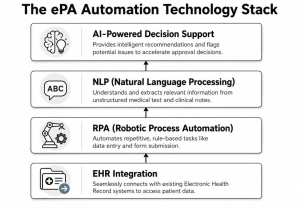
EHR integration
Everything starts with access to the clinical and demographic record. If the platform can’t reliably pull the order, diagnosis, prior treatment context, patient identifiers, and provider details from the EHR, staff will end up filling the gaps manually.
Strong EHR integration does three things well:
-
Prepopulates request data so teams don’t rekey core fields.
-
Triggers work at the right point in scheduling or ordering.
-
Writes status back into a visible queue so nobody has to hunt for updates.
Without that foundation, even advanced automation turns into another disconnected worklist.
RPA for legacy payer workflows
Robotic Process Automation, or RPA, handles repetitive, rule-based actions. In prior auth, that often means logging into payer portals, entering data, uploading documents, checking status, and moving information back into a centralized queue.
RPA matters because the payer environment is uneven. Some payers support modern exchange patterns. Others still rely heavily on web portals and document uploads. If your automation strategy only works when a clean API exists, your staff will still spend a large share of time in manual fallback mode.
A good RPA layer gives the operation coverage across those legacy scenarios. It isn’t glamorous, but it is often what makes the business case work.
NLP for clinical and policy interpretation
Natural Language Processing, or NLP, reads unstructured text. In ePA, that usually means clinical notes, scanned documents, operative plans, and medical policies that weren’t designed for machine readability.
Many organizations often underestimate the problem. Much of prior auth is not about moving fields from one screen to another. It’s about extracting the right evidence from narrative content and matching it to payer criteria.
AI-driven logic and adjudication support
This is the part that turns automation from clerical assistance into workflow acceleration.
That capability matters for executives because payer policy is where many delays begin. When staff must interpret a PDF, decide what evidence counts, and build the request manually, throughput falls. When policy logic is converted into a structured path, the system can ask for the right inputs earlier and route the request more intelligently.
A workable stack usually looks like this:
|
Component |
Job in the workflow |
Executive impact |
|---|---|---|
|
EHR integration |
Pulls patient, order, and clinical data |
Less manual entry, fewer intake errors |
|
RPA |
Navigates portals and repetitive submission tasks |
Broader payer coverage without extra headcount |
|
NLP |
Extracts facts from notes and documents |
Better documentation completeness |
|
AI decision support |
Maps policy rules to structured logic |
Faster submissions and cleaner exception routing |
Buy for coverage, not just elegance. The platform that handles both modern APIs and ugly legacy workflows usually creates more financial value than the platform with the cleanest demo.
From Administrative Burden to Accelerated Cash Flow
The ROI conversation gets stronger when leaders stop measuring ePA automation as a labor tool and start measuring it as a revenue acceleration tool. The point isn’t only to save staff time. The point is to submit cleaner requests, reduce preventable denials, shorten approval cycles, and move claims through the rest of the revenue cycle with less friction.

Translating workflow gains into financial outcomes
When prior authorization processing time falls, several financial effects follow.
-
Fewer scheduling disruptions: Services don’t stall while teams wait for missing documentation.
-
Cleaner claims entry: Approved services are less likely to hit preventable authorization denials later.
-
Less rework: Staff spend less time on status checks, appeals prep, and retroactive fixes.
-
Faster conversion to cash: Requests move earlier, approvals arrive sooner, and claims can progress without avoidable holds.
In practice, the biggest value often comes from reduced variance. Leaders can manage a process when it is consistent. They struggle when some payers answer digitally, others require portals, and staff members each use a different workaround.
Where executives should look for ROI
The strongest ePA business cases usually show up in a few operational metrics first, then in financial metrics later.
|
Operational lever |
What improves |
Why finance should care |
|---|---|---|
|
Submission quality |
More complete requests at first pass |
Reduces denial and appeal burden |
|
Cycle time |
Faster movement from order to decision |
Supports earlier claim progression |
|
Staff utilization |
Less portal and phone work |
Labor shifts to higher-value tasks |
|
Documentation consistency |
Fewer missing attachments and mismatches |
Lowers avoidable revenue leakage |
This walkthrough gives a quick look at how automated prior authorization workflows are being framed in the market today:
Financial lens: If authorization stays manual, the organization pays twice. Once in administrative effort, and again in delayed or denied revenue.
The key is not to treat these savings as isolated automation wins. Electronic prior authorization automation affects the quality of the claim before the claim exists. That makes it one of the few front-end interventions that can improve both patient access operations and back-end collections.
Navigating Common ePA Implementation Hurdles
A large share of prior authorization work still breaks outside a fully electronic path. That gap matters because every exception path adds labor, slows treatment, and creates avoidable revenue risk.

The operational problem is straightforward. ePA automation depends on clean inputs, predictable payer rules, and enough technical capacity to support multiple workflows. Hospitals rarely get all three at once. One service line may be ready for direct API exchange, while another still relies on scanned notes, payer portals, and local workarounds.
A useful warning comes from MACPAC. Its 2025 analysis highlights variation in provider technical capacity to meet new CMS API mandates that are scheduled to become effective in January 2027. For executives, this is not just a policy issue. It affects capital planning, rollout pace, and the level of manual support the organization will still need.
The zero-touch assumption causes bad planning
A full zero-touch model is unrealistic across all payers, specialties, and facilities. The better target is selective automation with strong exception handling and clear accountability.
The main obstacles usually fall into four categories:
-
Payer connectivity gaps: Some plans support structured electronic exchange. Others still require portal entry, fax, or manual attachment handling.
-
Fragmented source systems: Older EHR builds, scheduling tools, and referral workflows often pass incomplete or inconsistent data.
-
Clinical documentation in unstructured formats: Medical necessity support may sit in free-text notes, scanned PDFs, or specialty templates that are hard to parse without NLP or manual review.
-
Low staff trust: Teams that have seen failed automation pilots will keep parallel checks in place until accuracy is proven in daily operations.
These are not minor workflow annoyances. They determine whether automation reduces cost or shifts work from one queue to another.
What works in practice
Hospitals that get measurable ROI usually design around operational variation from the start. They do not buy an ePA tool and assume the workflow will standardize itself.
A workable model includes:
- Multiple submission methods by payer type. Use API exchange where payer connectivity supports it. Use RPA for portal-driven plans. Use document extraction and routing when supporting records are still unstructured.
- Front-end data cleanup before broad automation. If orders, diagnosis details, and attachments are inconsistent, bots and rules engines will reproduce those defects at scale.
- Complexity-based routing. High-volume, rules-based cases should move automatically. Cases with clinical nuance, missing evidence, or specialty-specific requirements should go to trained staff with the right context.
- Visible exception management. Staff need to see why a case was routed, what failed, and what action is required. Hidden logic creates rework and resistance.
The technical components translate into business value. RPA reduces repetitive portal labor. NLP helps extract required clinical content from notes and attachments. Used together, they improve first-pass quality and shorten authorization cycle time. Used poorly, they automate bad intake.
For leaders comparing operating models, GeBBS makes the case clearly in its discussion of why pre-authorization as a service requires both technology and human components.
Systems break when they assume every payer is digitally mature, every chart is structured, and every clinic documents care the same way.
Enterprise variation is usually the real blocker
The hardest implementation issue is often internal variation across the health system.
A flagship hospital may have stronger interfaces, centralized authorization teams, and better template discipline. An acquired practice or smaller facility may still depend on fax intake and local staff knowledge. If leadership applies one operating model to both, performance will split quickly. One group gets faster decisions and cleaner downstream claims. Another group keeps the same denials and manual workload, now with added technology cost.
That is why rollout planning should segment by facility, specialty, payer mix, and documentation maturity. Executives should expect different automation rates, different staffing models, and different ROI timing across the enterprise. That is not a sign the strategy is failing. It is the technical and financial reality of ePA adoption.
A Strategic Roadmap for ePA Automation Success
The strongest electronic prior authorization automation programs usually follow a phased rollout. That sounds slower than a big-bang deployment, but it tends to produce better control, faster trust, and cleaner ROI validation.
Start with a narrow business case
Don’t begin by automating every authorization workflow in the organization. Start where the pain is obvious and measurable. High-volume specialties, high-documentation service lines, and payers with stable rules are often the right first targets.
Leadership should align on a few questions first:
-
Which service lines create the most authorization friction?
-
Where do staff spend the most manual effort?
-
Which payer pathways are repetitive enough to automate safely?
-
What operational outcomes matter most to finance and operations?
This is also the point to define governance. Someone needs authority over workflow design, exception rules, IT coordination, and performance review. Without that ownership, the project drifts into vendor management instead of operational change.
Evaluate platforms the way operators work
Procurement teams often focus on features. Operators care more about coverage and fit.
A realistic evaluation should test:
|
Evaluation area |
What to ask |
|---|---|
|
Integration |
Can it pull from the EHR and return status into existing queues? |
|
Connectivity |
Does it support both modern exchange methods and legacy portals? |
|
Documentation handling |
Can it work with structured data and narrative attachments? |
|
Exception workflow |
How are pended, incomplete, or clinically complex cases routed? |
|
Reporting |
Can leaders see where requests stall and why? |
A platform can look polished and still fail operationally if exception handling is weak. Prior auth is won or lost in the exceptions.
Pilot before enterprise rollout
A pilot should be big enough to reveal friction but small enough to manage closely. In practice, that means choosing a contained group of users, a finite payer set, and a defined service line.
During the pilot, watch for three things:
-
Workflow integrity: Are requests moving through the intended path, or are staff creating workarounds?
-
Documentation quality: Is the system reducing missing information?
-
Escalation logic: Are complex cases reaching the right human reviewer fast enough?
A pilot isn’t a proof of concept. It’s a proof that the operating model holds up under daily pressure.
Scale with process discipline
Enterprise rollout fails when organizations assume success in one department will naturally transfer everywhere else. It won’t. Specialty mix, documentation habits, and payer concentration all matter.
As the program scales, standardize these elements:
-
Work queue design
-
Escalation rules
-
Payer mapping
-
Documentation templates
-
Management reporting
One practical option in this phase is a blended model that combines internal teams with external operating support and automation tooling. GeBBS Healthcare Solutions is one example. Its prior authorization automation capabilities use RPA-driven submission and tracking, and its iCareONE platform supports automated initiation, status monitoring, eligibility verification, and EHR-connected workflows. The important point is not the brand. It’s whether the model combines technology with process ownership.
Scaling Automation with an Expert RCM Partner
Electronic prior authorization automation delivers value when organizations treat it as a revenue cycle transformation effort. The software matters. The workflow design matters more. Hospitals usually run into trouble when they automate fragments of the process but leave intake variation, payer complexity, and exception management untouched.
A strong partner helps in three places at once. First, it supports the technology stack needed for real-world ePA, including EHR-connected workflows, document handling, and portal automation. Second, it brings process discipline to intake, routing, escalation, and reporting. Third, it helps leadership scale the model beyond the first pilot without losing control of quality.
That combination is what turns automation into sustained financial performance rather than a short-lived project. For teams assessing operating models, GeBBS provides a practical example in this prior authorization automation case study for healthcare access and RCM.
If your hospital is evaluating electronic prior authorization automation, GeBBS Healthcare Solutions can help you assess current authorization bottlenecks, identify where RPA, NLP, and workflow redesign can produce measurable financial impact, and build an ePA model that fits both modern APIs and legacy payer realities.